
The Aviation Act regulates Schiphol Airport’s operating licence. The law also regulates how Schiphol Group can determine airline-related tariffs, including how high those tariffs can be.
The Aviation Act deals with aircraft, passengers and security-related fees. The law also contains provisions on the returns to be achieved. This should not exceed the weighted average cost of capital.
The Consumer & Market Authority (ACM) supervises the tariffs. In case of disagreement over these tariffs, the ACM will investigate whether any airline complaints are justified. In that case, we are obliged to set new rates.
An evaluation was made of the Aviation Act of 29 June 2006, and a new act has come into force as of 1 July 2017. Some parts of the Aviation Act with regard to the regulatory system have been amended. It concerns the following themes: consultation improvements; the introduction of multi-year charges and conditions; limiting rate fluctuations through settlement equalisation; the introduction of efficiency incentives on large investments; a mandatory contribution from non-aviation activities made to aviation activities; and the possible effects of charges on network quality.
The Allocation System describes which costs, revenues and assets are allocated to aviation activities (including security activities). The ACM approved an update of the Allocation System 2021-2024 in July 2021."
How much airport fees do you have to pay at Amsterdam Airport Schiphol? Please submit your flight details – including the aircraft type, maximum take-off weight (MTOW), parking time and number of boarding passengers - to our Customer Support Office for a custom-made advice. They calculate how much your airline has to pay.
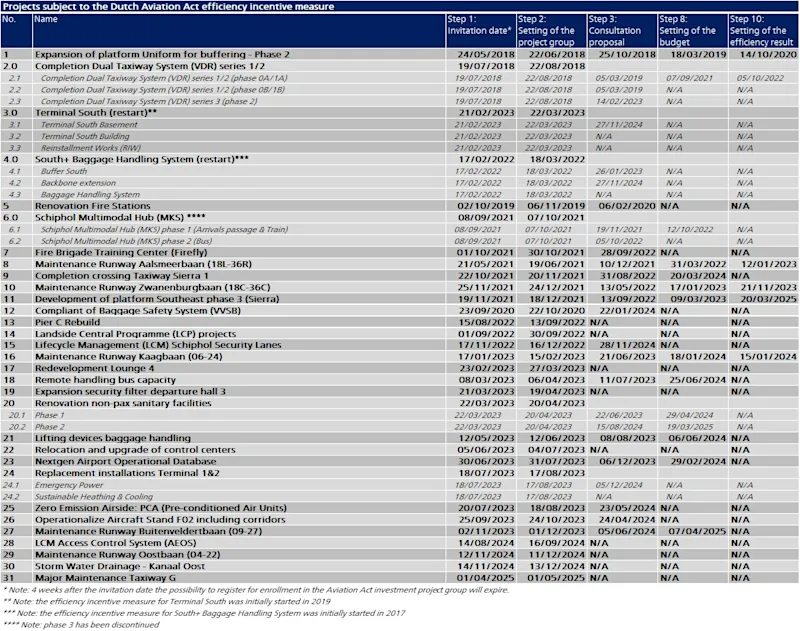
One of the amendments in the Aviation Act which has come into force as of July 1st, 2017, is the implementation of the efficiency incentive measure on large investment projects for which the capital expenditure for aviation activities amounts to at least 20 million euros. In case the actual capital expenditure exceeds the set budget by more than 5%, the variance will be fully absorbed by Schiphol for a certain period. In case the actual capital expenditure is more than 5% lower than the budget, the variance will be equally shared between Schiphol and the users for a certain period. This measure incentivises the airport’s operator to keep the actual expenditures within the budget.
The tender process or realisation of a number of investment projects or individual components thereof, may have already commenced upon the entry into force of the amended Aviation Act. As part of transitional law, the efficiency incentive measure only applies to investment projects for which tendering or realisation has started within three months after coming into force of the amended Aviation Act (Explanatory Memorandum). This means that investment projects for which tendering or realisation has started before October 1st, 2017, will not be subjected to the efficiency incentive measure.
This section contains the information with regard to the Regulatory Accounts. All documents published in this section are password protected as these are confidential. Furthermore, the information is only available for airlines or representative organisations operating at Amsterdam Airport Schiphol. Please send an email to airportcharges@schiphol.nl if you would like to receive this password.
As of July 2008, the EU Regulation 1107/2006 concerning ‘the rights of disabled persons and persons with reduced mobility (PRM) when travelling by air’ is effective. The assistance to PRM’s is financed in such a way as to spread the burden equitably among all passengers using the airport. For this reason, a PRM levy on a per passenger basis applies, which is charged to all airlines operating at Amsterdam Airport Schiphol.
For general information on airport charges please contact Pricing & Regulatory Affairs on +31 20 601 2689 or airportcharges@schiphol.nl.
For questions on invoices please contact Airport Administration on +31 20 601 2416 or airportadministration@schiphol.nl.